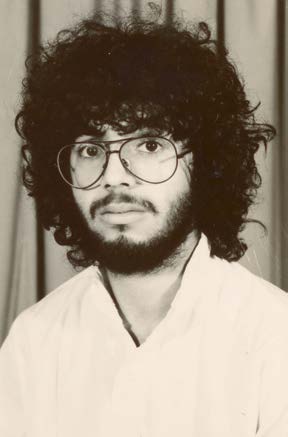
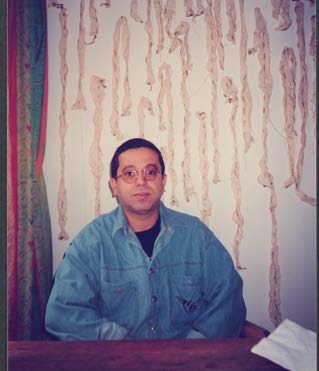
Mohamad Ahmed Ibrahim was born in 1962 in Khor Fakkan, on the east coast of the UAE, at a time when the town was still a small coastal settlement. As a child, he was energetic and often in trouble at school, yet he formed close bonds with his art, Arabic and geography teachers. They made teaching materials by hand, and he became absorbed in the act of drawing and using colour, often sketching faces without thinking of them as formal portraits. Both his teachers and his family encouraged him, especially his father, a former pearl diver who later worked as a sailor and travelled widely despite being illiterate. His father’s curiosity and openness to the world left a lasting impression.
In his mid-teens, Ibrahim encountered an image and description of Picasso’s Guernica in an Arabic newspaper. The work’s distorted figures and emotional intensity revealed that art could move beyond likeness and beauty to carry ideas and political weight. This moment reshaped his understanding of what art could be. Although he did not go on to study art formally, choosing psychology instead, he saw clear connections between the two fields, both concerned with perception, thought and emotion.
Determined to educate himself, he began reading art books sent by a relative abroad. Because many were in English or German, he translated them slowly with a dictionary, sometimes spending months on a single volume. Through this process, he encountered a wide range of art histories and movements. A key influence was Paul Klee’s The Thinking Eye, which resonated with him not stylistically but conceptually, particularly Klee’s ideas about the point, movement and the spiritual dimensions of form, which Ibrahim linked to Arab philosophical and Sufi traditions.
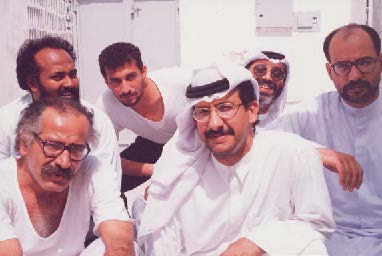
In the mid-1980s, access to good materials in the UAE was limited. The artist joined a workshop in Sharjah where he learned practical skills, from stretching canvases to working with watercolour, oil and acrylic. Improvisation became essential; at times he used tent fabric as canvas. Around 1987, he began producing work more seriously when Ibrahim met the artist Hassan Sharif. Their encounter marked the beginning of a long intellectual and artistic dialogue. Through Sharif, he became connected to a circle that included Hussain Sharif, Abdullah Al Saadi and Mohammed Kazem – artists who would later be recognised as central figures in the development of conceptual and experimental art in the UAE. Their exchanges were driven less by stylistic similarity than by shared questions about form, process and presentation.
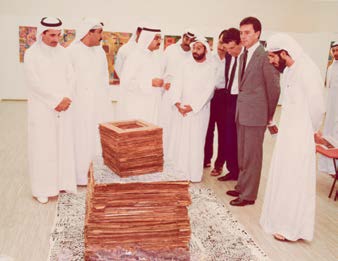
His first exhibition experience was difficult. When several of his works were proposed for a group show, most were rejected. One was eventually included, but later exhibitions saw his pieces marginalised within the display. These experiences were painful but also strengthened his resolve. He continued to exhibit, and solo shows became, for him, moments of transition, a way to close one chapter of work and move into another.
In the 1990s, an important friendship with Jos Clevers, the Dutch artist, opened the door to extended stays in the Netherlands. There, he worked in a studio environment and participated in exhibitions that challenged the notion that there was no serious contemporary art emerging from the Gulf at the time. These experiences broadened his network and placed his work in an international context. He also took part in biennales and exhibitions in different countries, reinforcing his belief that artistic language could travel across cultures.
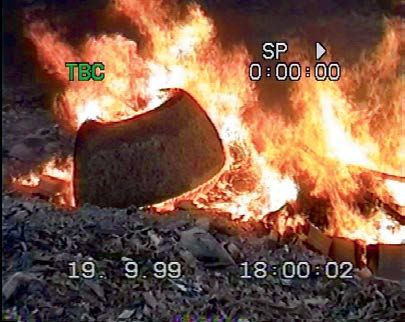
A dramatic turning point came in 1999, when, after leaving a job and facing practical pressures, he burned a large body of his own earlier work. The act was driven less by symbolism than by circumstance and emotional strain. In the aftermath, he experienced a period of depression where he found solace in gardening. At the request of his wife, Ibrahim returned to the Netherlands for a year and he soon returned to drawing.
For several years, the artist balanced art with other employment, including work in the banking sector. Even then, he drew whenever he could, keeping materials close at hand. Eventually, he chose to leave stable employment to devote himself fully to art.
Today, his practice continues a long-standing investigation into basic forms. He reduces objects and landscapes to elemental shapes – circles, lines, simple structures – seeking what lies beneath appearances. Mountains and the sea, drawn from his childhood environment, have become recurring themes, not as literal depictions but as distilled visual ideas. He also experiments with natural materials such as soil, leaves and organic matter, bringing physical traces of the land into his work.
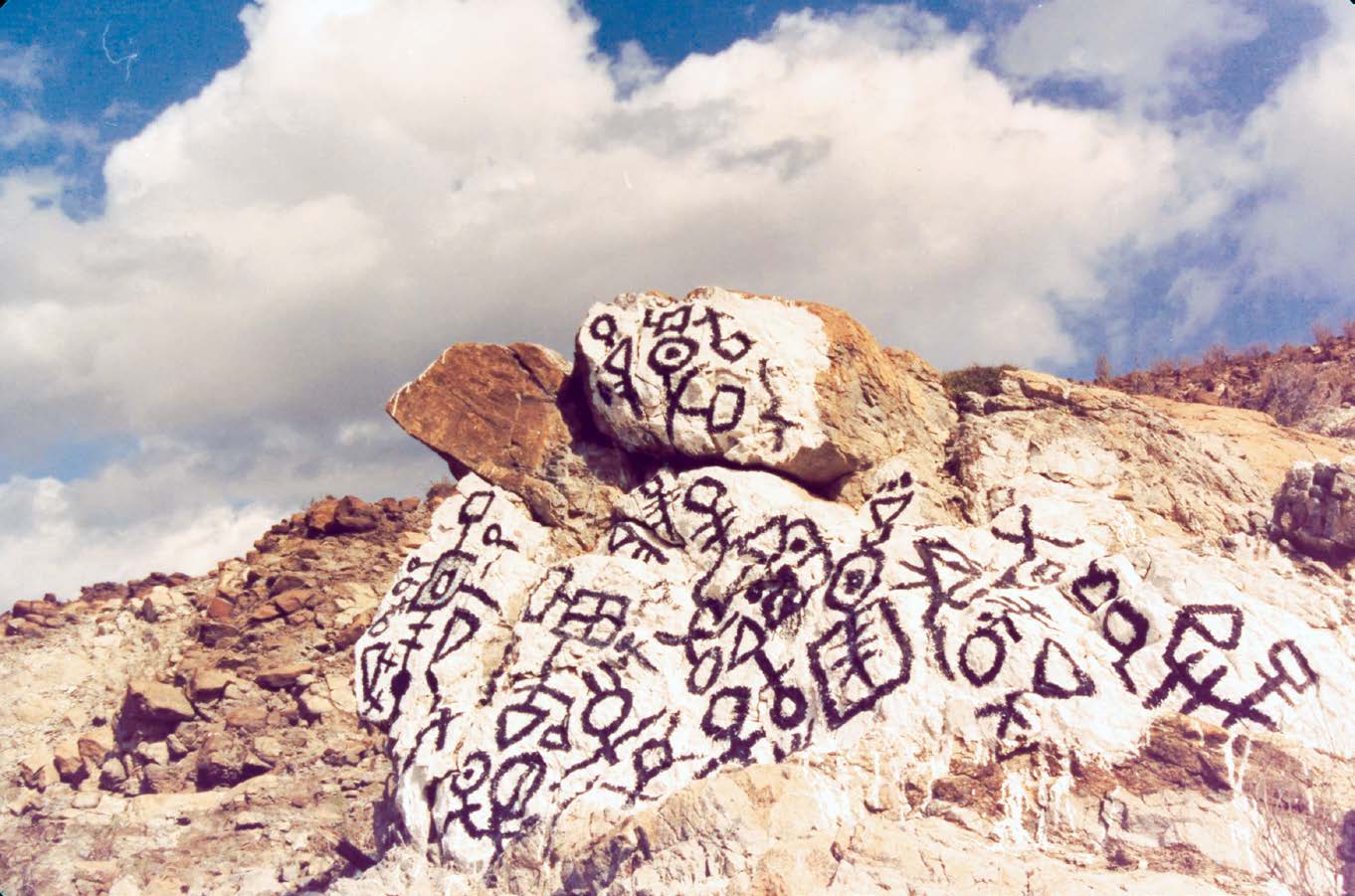
Across decades, Mohamad Ahmed Ibrahim’s journey has been shaped by self-education, dialogue, material improvisation and an unwavering belief in art as a reflection of inner and outer worlds. From a curious child drawing faces in a coastal classroom to an artist refining symbols drawn from land and sea, his path traces the growth of a practice rooted in place yet open to the wider world.
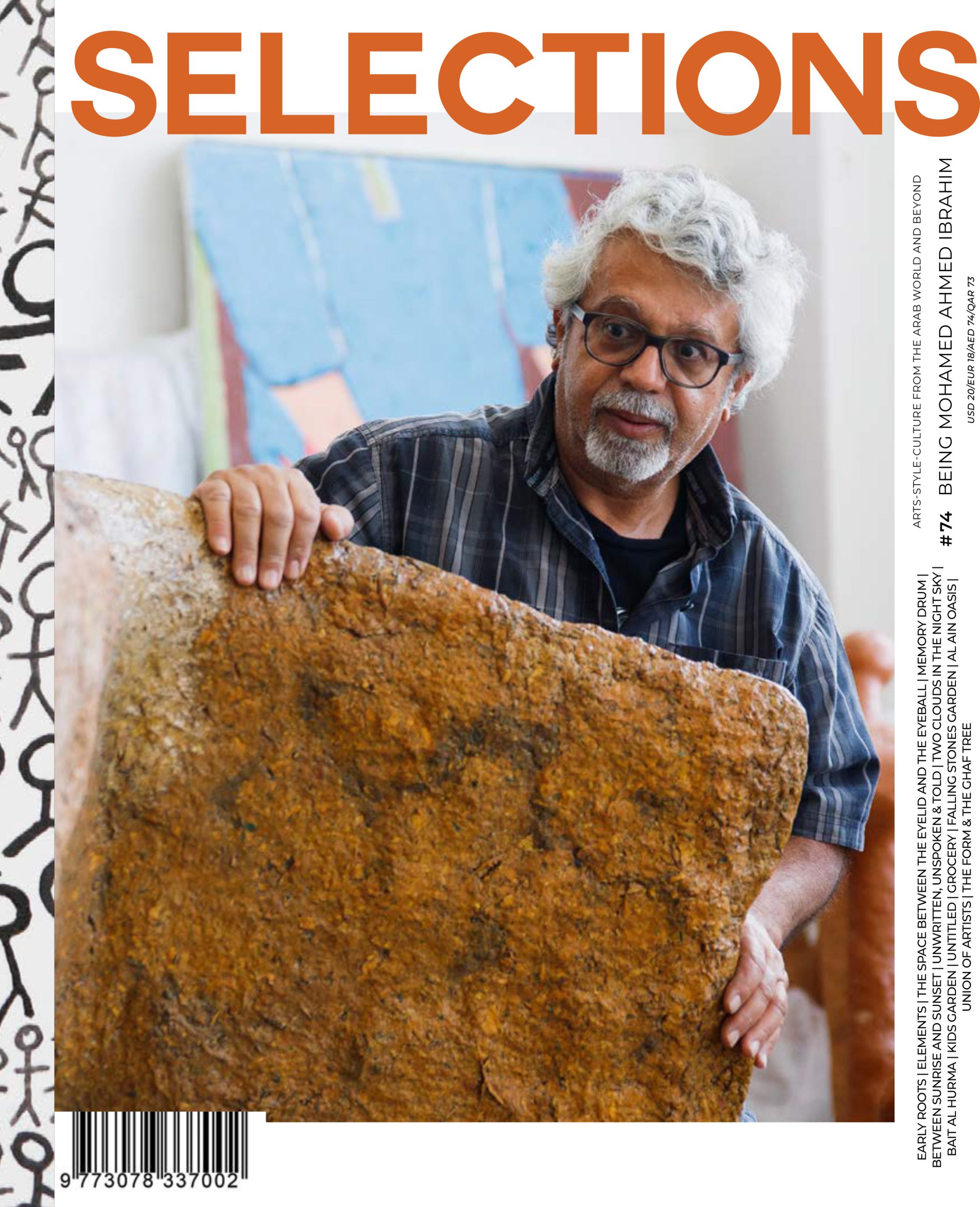
Selections’ issue #74 Being Mohamed Ahmed Ibrahim traces the life and practice of Mohamad Ahmed Ibrahim, an artist whose vividly coloured, repeating forms carry both playfulness and depth. Emerging in a period when the UAE had little contemporary art infrastructure, Ibrahim helped shape an early experimental community alongside a small circle of peers, building a language rooted in persistence and imagination rather than institutional support.
The publication follows his journey from these formative years to major international recognition, including Desert X AlUla (2020), the UAE Pavilion at the Venice Biennale (2022), and works entering the Guggenheim collection (2024). At its core, the issue presents Ibrahim’s work as an enduring meditation on colour, repetition, landscape, and joy as a serious artistic pursuit.