Wael Shawky’s work often unfolds like a story told across borders, belief systems, and eras. Born in Alexandria in 1971, he spent much of his childhood in Mecca, where his father, an architect, had moved the family in the 1970s to work on infrastructure serving pilgrims. Those early years left a lasting imprint. Mecca, as he remembers it, was at once deeply conservative and unexpectedly cosmopolitan — a place where tribal societies, religious authority, migrant communities, and imported models of modernity coexisted in proximity. Children from Yemen, Africa, and across the Muslim world shared classrooms, while different social systems operated side by side, rarely merging yet constantly visible to one another.

This experience of parallel worlds – not simply opposites, but distinct realities occupying the same space – would become a key conceptual thread in Shawky’s later practice. As a child, he also developed a close relationship to language and faith, drawn to the cadence of Quranic Arabic and the atmosphere surrounding the Great Mosque. Yet life in Saudi Arabia was socially restrictive, and as an outsider he often felt the weight of tribal belonging. When the family returned to Alexandria for longer stretches, another dislocation followed. Having grown up elsewhere, he struggled to readjust to Egyptian schools and social codes. The oscillation between Egypt and Saudi Arabia sharpened his awareness of how identities are shaped by place, education, and systems of power.
By his mid-teens, Shawky was already drawing with unusual skill, though he initially assumed this was unremarkable. His mother encouraged his artistic inclinations, recognising his sensibility early on, while his father hoped he might pursue architecture. After his mother’s sudden death when he was seventeen, art remained less a declared choice than a persistent condition – something he had always done and could not quite abandon. He enrolled at the Faculty of Fine Arts at Alexandria University, where the training was rooted in classical technique. For a time, being an artist simply meant mastering drawing and painting.
A turning point came when a friend introduced him to Farouk Wahba at the Alexandria Atelier. Through Wahba, Shawky encountered modern and contemporary art beyond academic realism – the work of figures such as Joseph Beuys and Gerhard Richter. Without the internet, and with few museums available to him, his education became self-directed and intensive. He spent long hours in the libraries of the Fine Arts faculty, the Goethe-Institut, and the American Cultural Center, piecing together an understanding of global art histories through books. Gradually, his definition of art expanded from image-making to idea, space, and experience.

Biennial 14: ‘Leaving the Echo Chamber’. Commissioned by Sharjah Foundation and supported by Abdelmonem Bin Eisa Al Serkal.
By his early twenties, Shawky was experimenting with installation. Works such as Refined Society (1993) and Taste Pollution transformed rooms into immersive environments layered with painted surfaces, objects, and living elements, including flies whose movements became part of the composition. Though he later described these works as naïve, they marked his first sustained attempts to construct symbolic “societies” within enclosed spaces – microcosms reflecting broader social tensions.
National recognition arrived in the mid-1990s when he represented Egypt at the Cairo Biennial. His installation Frozen Nubia responded to the displacement of Nubian communities following the construction of the Aswan High Dam, reflecting on how the forced movement of people can fracture and erase cultural memory. The work earned him Egypt’s grand prize and signalled a deepening engagement with history, migration, and the fragility of civilisations, themes that would continue to shape his practice.

Despite early acclaim at home, the international art world of the 1990s offered little visibility to artists from the region. Shawky taught at Alexandria University but sought broader intellectual exchange. In 1999, he left for the United States to pursue a Master of Fine Arts at the University of Pennsylvania. The experience provided access to critical discourse and studio resources that had been scarce in Egypt, situating his work within wider theoretical and artistic debates.
When he returned to the region in the early 2000s, the cultural landscape was shifting. Independent art spaces such as Townhouse in Cairo and Ashkal Alwan in Beirut were emerging as vital platforms for experimentation and dialogue. Within this context, Shawky developed projects that wove together performance, narrative, and collective ritual, including The Moulid of Sidi El Asphalt (2001). These works drew international curatorial attention and led to his inclusion in the 2003 Venice Biennale, a milestone that marked his entry onto a global stage.


Across subsequent decades, Shawky has become known for complex, research-driven projects that revisit historical narratives through theatre, film, music, and craft traditions. Whether working with marionettes, children’s choirs, or historical texts, he approaches history as something staged, translated, and retold rather than fixed. His practice reflects a lifelong negotiation between cultures, languages, and systems of belief; an inquiry rooted in childhood experiences of living between worlds, and sustained by a commitment to re-examining how stories shape collective memory.
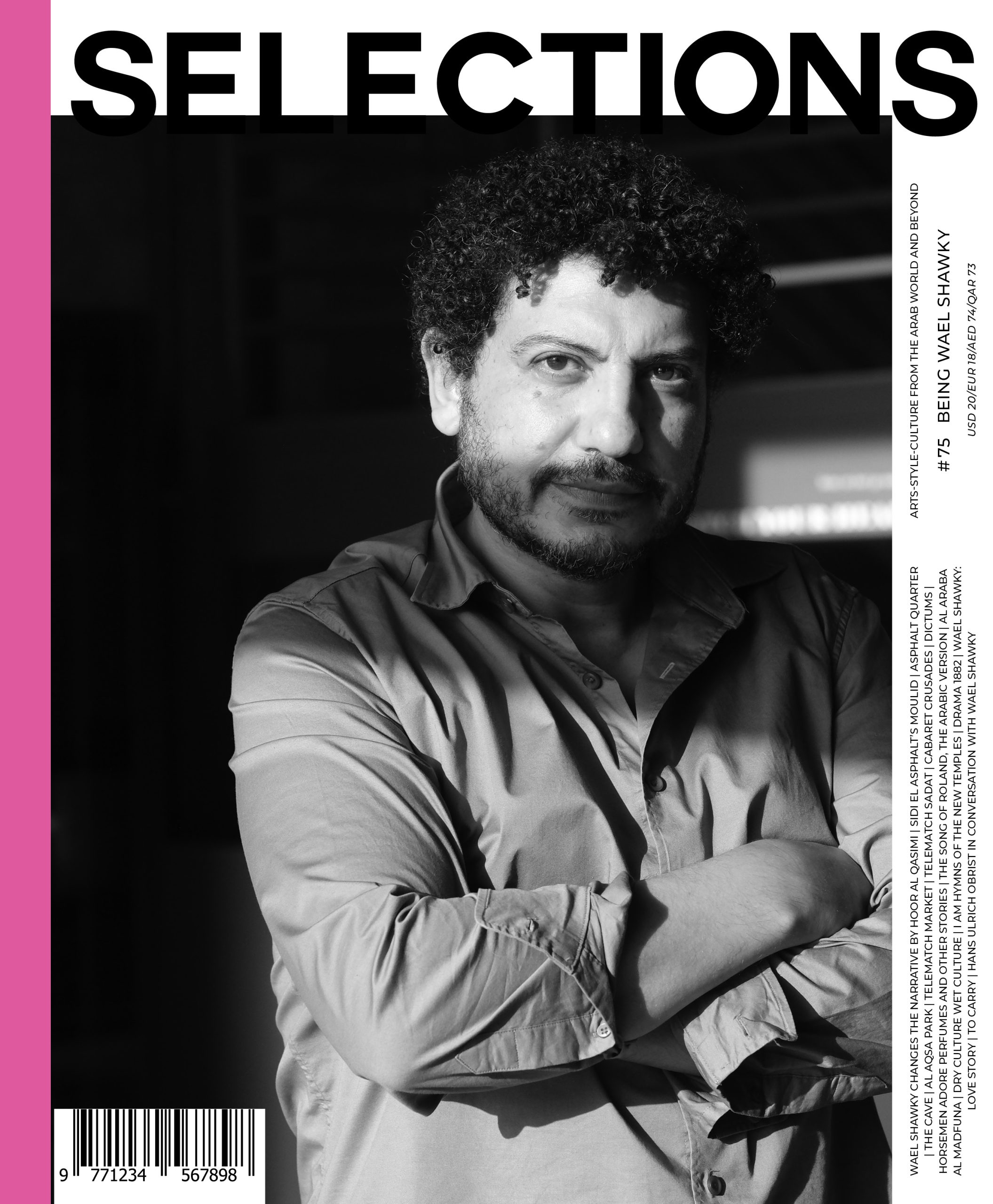
Selections’ issue #75 Being Wael Shawky traces the arc of Wael Shawky’s practice, where rigorous historical inquiry meets poetic, time-based form.
Throughout the four chapters; Traces Of Becoming, Architectures Of Narrative Files, Hidden Worlds, and Politics, Performance, & Myth, the publication reflects Shawky’s role in shaping artistic infrastructure, from founding MASS Alexandria to leading programmes at the Fire Station in Doha. Appearing at a pivotal moment in his international trajectory, the issue brings together voices, collaborations, and long-term research that illuminate an artist whose work bridges scholarship, imagination, and cultural pedagogy. Click here to buy the issue.