Mesh & Mayhem marks Tabari Art Space’s first exhibition dedicated to the digital sphere. Curated by Salem AlSuwaidi, Emirati artist Talal Al Najjar examines how digital simulation reshapes memory, landscape, and identity. His multimedia practice – spanning video, sculpture, and CGI – dissects the overlaps between technology and heritage, offering a fragmented portrait of the Gulf’s imagined futures. In this conversation, Talal Al Najjar (T.N) reflects on the impulses behind Mesh & Mayhem, his fascination with repetition and absurdity, and the tension between precision and chaos that defines his work.

Can you walk us through the process of creating art in the digital world? How do you choose the right medium for a particular idea, and how do those choices affect how the viewer experiences the work?
T.N: I find that I approach my work with the same structural logic, whatever medium I may be working in, and they bleed into each other. Sometimes I decide that video/animation is the right medium to convey certain things, but again, you end up seeing elements of that back into my physical works. In MESH & MAYHEM I have a film titled FACES that is a combination of handheld filming in different locations across Europe (investigating gargoyles, grotesques, and even mannequins) with CGI elements depicting faces of cyborg-like humanoids, dogs, monkeys, fossils, and creatures. I like meshing them together. However, in a 2023 work titled Petro-Ghareebo: NAUSEA I found that straight animation within a world I built in a game engine was the best choice, as I could create cinematography that I couldn’t do physically – rollercoaster and glitchy drone-like shots, creating a vertigo-inducing effect that I wanted to achieve, and viewers did feel that.
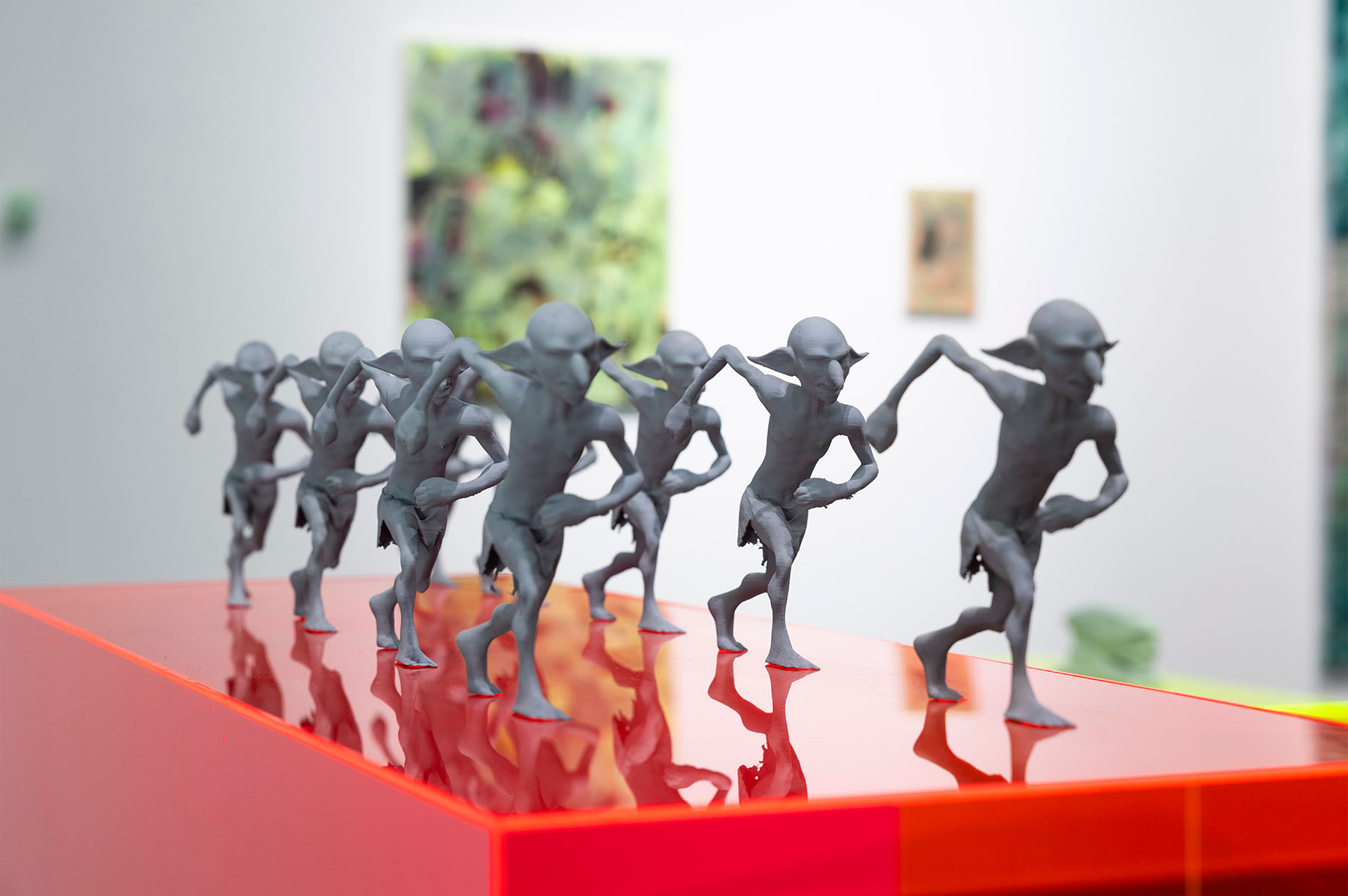
You’ve created an intentionally “excessive” body of work for this show. What does this abundance say about simulation, consumption, and the instability of meaning in the digital age?
T.N: I love creating a space that is overstimulating to some degree. I’m personally a maximalist too. There’s an element of general noise, and I like the idea of each work or installation enticing or seducing the viewer to investigate it – fighting for attention sometimes. In MESH & MAYHEM, I have a multi-channel video installation titled AVATARS that features five screens, each with an animated avatar animation looping while proclaiming statements relating to the ideas of mesh and how Salem AlSuwaidi (the curator) and I were thinking of it in all its forms – deconstructing and reconstructing. Some spoke philosophically while some spoke very absurdly or even caveman-like, with different voices and accents. However, they are all speaking over and interrupting each other – so a viewer must engage closely to each one to actually have the statements be intelligible, otherwise its a mesh of them all, again creating abstract noise. This is reflective of the excess noise and instability of meaning in the digital age because things get lost or misunderstood unless further investigated.
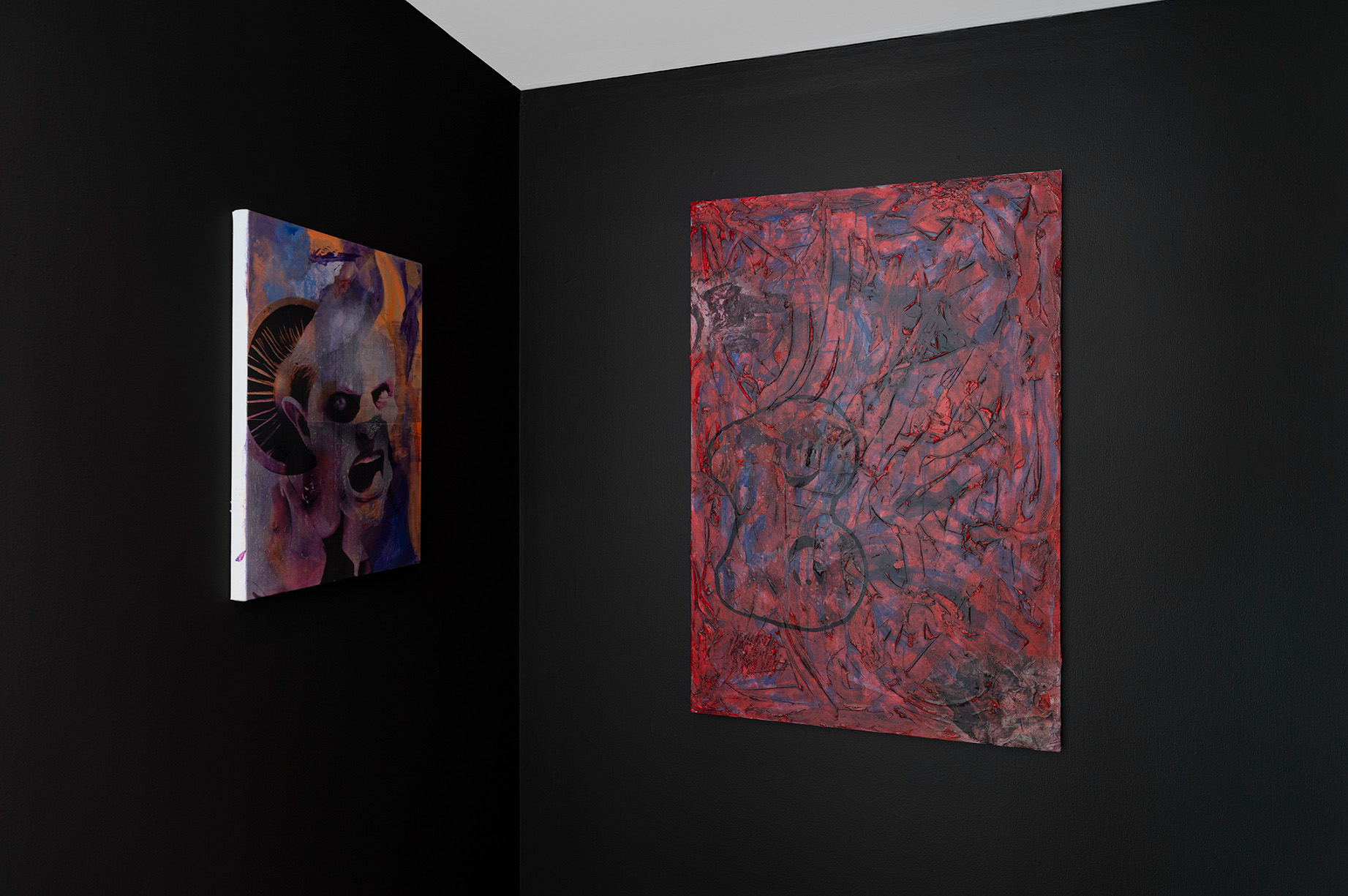
In Mesh & Mayhem, you describe repetition not as duplication but as excess. How do you see this excess reflecting our current digital condition, and what emotional or psychological effects do you hope it triggers in the viewer?
T.N: Our excessive digital condition has definitely had profound psychological effects on humans and society. Desensitisation is extremely evident, whether to violence, pleasure, emotions, or images in general. We consume a million things a day now, and our brains are fried. In my work, I convey the world and its subjects/objects the way I see things – as absurd, for all the good and bad – while incorporating humour – and my material reality is also the excess and mayhem we live in now. I like for viewers to really engage with each work and have to decrypt it at times, but I like provoking a sense of odd familiarity yet an alienness as well.
Location: Tabari Art Space, Dubai, UAE.
Date: 27 September until 24 October 2025
About Talal Al Najjar
Talal Al Najjar is an Emirati artist based between Los Angeles and Dubai. His interdisciplinary practice – spanning sculpture, video, sound, CGI animation, painting, and installation – investigates how material culture and imagery can be recontextualised through irony and defamiliarisation. Using an absurdist lens, Al Najjar examines simulation, postproduction, counter-futurisms, and postmodern conditions to raise anthropological and material questions about the contemporary world. A graduate of ArtCenter College of Design (MFA, 2023) and the School of the Art Institute of Chicago (BFA, 2021), he has exhibited widely across the UAE and the United States. He is a recipient of the ICD Brookfield Place Arts Residency (2023) and the Dirwaza Creative Access Grant (2022).