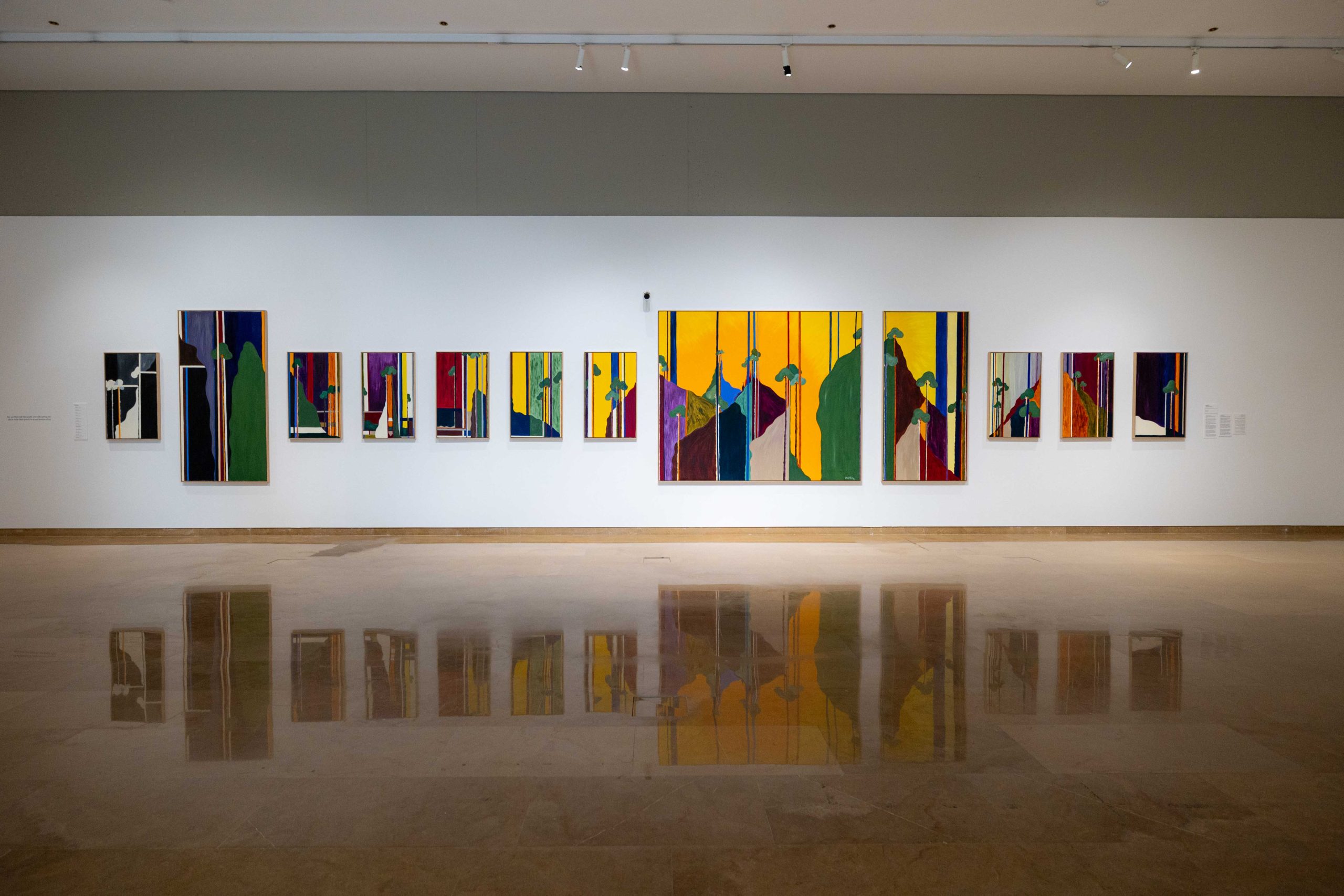
Echoes of Existence opened last week at Nuhad Es-Said Pavilion for Culture in Beirut, exploring the pine tree as a shared symbol of cultural memory connecting Lebanon and Italy. Curated by Muriel Asmar and initiated by the Embassy of Italy in Lebanon, the exhibition brings together works by Enzo Cucchi and Gilbert Halaby alongside paintings by Lebanese modern masters, while an environmental collaboration with the Carabinieri Biodiversity and Forestry Units expands its dialogue beyond art. On the occasion of the exhibition, Selections spoke with Gilbert Halaby (G.H.) about landscape, memory, environment, and artistic exchange across the Mediterranean.
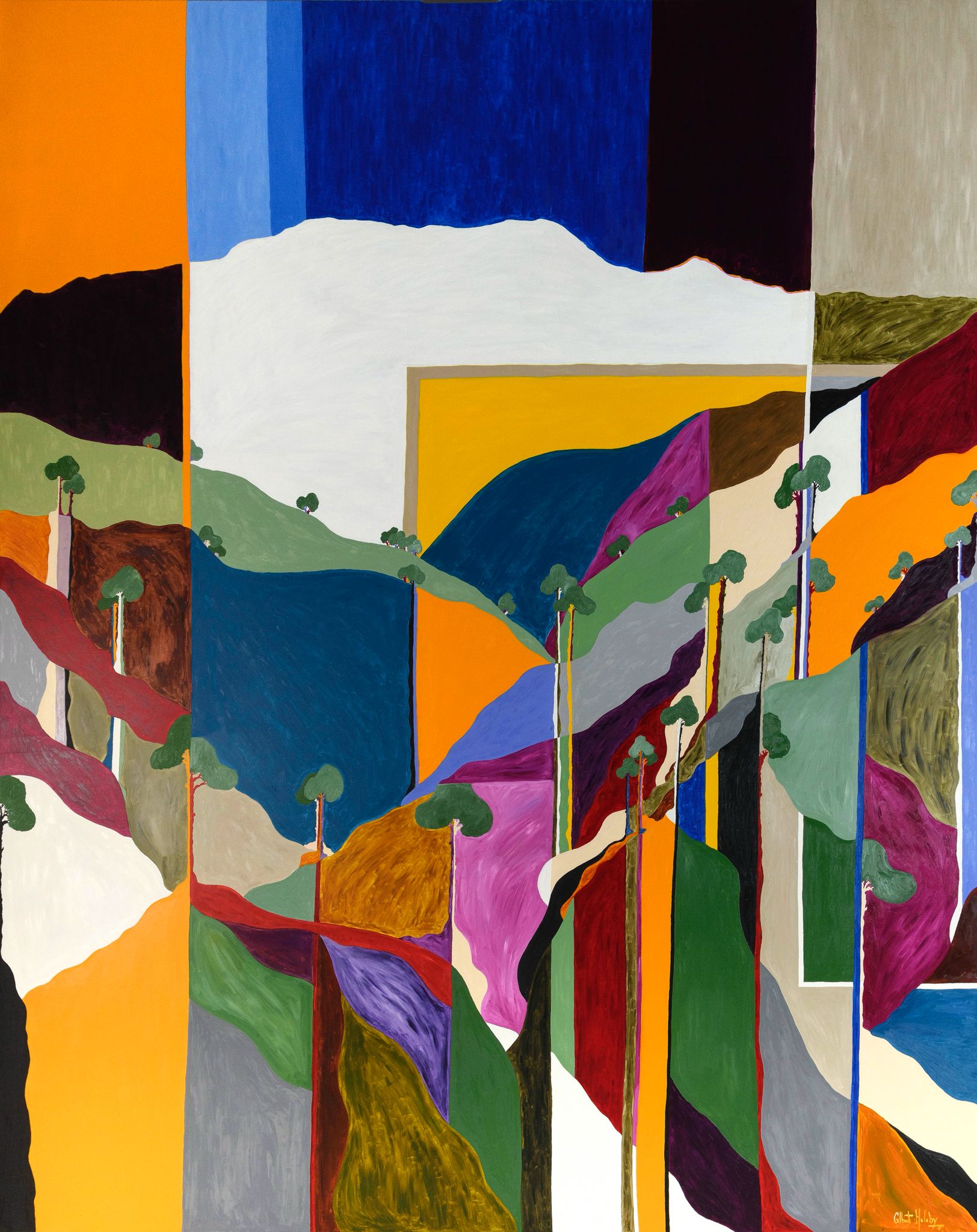
The pine tree carries deep cultural and ecological significance in both Lebanon and Italy. How did this shared Mediterranean symbol become the conceptual anchor of your dialogue with Enzo Cucchi, and what possibilities did it open within your own practice?
G.H: The pine tree was part, an indelible part, actually, in my childhood, in the landscape of my childhood. It is rooted deep inside my heart, inside my memory.
And it’s the land, it’s the skyline in Rome, and it has always been regarded less, less ceremonial, let’s say, in Lebanon, than the cedar tree or the olive trees because of the production and their importance to Lebanese society and communities.
However, the pine tree for me, and I think for Enzo as well, is a sentinel for the memory. That shape, that prolongated shape that goes up to the sky and then flourishes in the sky with this magnificent form is very significant. It is rooted in our hearts in different ways. We do not paint in the same way. We have different styles. We come from different generations. However, the pine tree is present in our sight, in our memory, and in our horizon, in our future.
Regarding how it influenced my own practice; it changed it, actually. It’s been a year and a half since the verticality of the pine tree cuts my skies, cuts my horizons. And this verticality is the memory of the child that used to look up to the giant friend, the giant tree, and sees it like a poem of words that cuts all the way, goes up and up into the sky. So, whatever you see as vertical in this series of work, it is caused by this memory and by that slender trunk of the pine tree that goes and caresses the blue of the sky.

Your paintings in Echoes of Existence move between landscape and memory, often dissolving the boundary between observation and emotion. How has living in Italy for more than two decades reshaped your relationship to the Lebanese landscape that continues to recur in your work?
G.H: Well, it didn’t reshape it; it matured it. I had to live what I lived, and travel, and land in Italy, to become the painter that I was when I was four, when I dreamed of becoming a painter.
So, this landscape, this life, landscape of life more than landscape of things that I see; matured, the internal landscape. It matured the man; and the painter, and it matured the vision, the desire for colour into applying the colour on a canvas.
So, my life and my experience here, and this country that welcomed me as its own son, matured the will to paint, the will to become who I am today, the will to continue and prosper, but without eradicating the roots of my motherland, which is Lebanon. On the contrary, it’s this marriage between childhood, the memories, and the current daily inspirations that enriches the landscape expression without eliminating any element of what it was, where do I come from, and I think where I will be going, heading.
The exhibition places your work alongside paintings by Omar Onsi, Moustafa Farroukh, César Gemayel and Aref El Rayess, creating a conversation across generations of Lebanese artists. How do you see your practice extending – or departing from – that artistic lineage?
G.H: I am thankful and grateful for this exhibition because it placed me on a map that I didn’t know; I left Lebanon very early in my life, and I am a little bit far from the Lebanese masters. And with this exhibition, I discovered where I come from, where my roots, visually and artistically talking, are.
And I realised, when I saw the Saliba Douaihy painting, which was painted in 1960 – circa 1960 – I saw the cliffs that I paint without knowing that he painted that. So, we are the sons of the same land, landscape, vision, and horizon. And we paint differently; we use different colours, we have different styles, but we stem from the same land.
And I am very honoured to be even present with all of them at Nuhad Es-Said Pavilion for Culture. I discovered a treasure of history that I didn’t know before, and I am an extension, as we all are with them before me, of the same land and of the same horizon, filled with cliffs towards the sea, towards the future, towards new lands and new windows of light and life.

At a moment when environmental concerns are inseparable from questions of cultural heritage, how do you see Echoes of Existence contributing to this debate?
G.H: The core of Echoes of Existence, of this exhibition, is the mission of awareness regarding the big problem that is facing the pine trees in Italy and in Lebanon as well. The pine trees are being attacked by a worm called ‘Toumeyella parvicornis’, and it’s a sap-sucking worm that attacks the internal, the inside of the trunks of the trees and actually sucks all of the life out of the tree and kills it. So, I hope this exhibition brings awareness, and we can help in any way to safeguard our forests.
In Lebanon, we do not really look at the pine tree as a precious tree, but it is. It is everywhere, at every corner, in every landscape. So, I hope that this exhibition will change a little bit the view in the eyes of the Lebanese regarding the pine trees. They are extremely important for our landscape, and we have to try our best to save them.
Location: Nuhad Es-Said Pavilion for Culture within the National Museum of Beirut
Duration: From 22 July until 21 October 2026
About Gilbert Halaby

Born in Lebanon, Gilbert Halaby developed an early fascination with drawing, shaped by the landscapes of Mount Lebanon, where olive groves and pine forests continue to inform his visual language. After studying archaeology at the Lebanese University, he settled in Rome in 2003, establishing his studio as both a workspace and a gathering place for artistic exchange. Although self-taught, Halaby has quickly gained international recognition through a series of solo exhibitions across Beirut, Rome, Abu Dhabi, Greece, London and Palm Beach. His paintings are held in prominent public and private collections, including the Lebanese Presidential Contemporary Collection and several institutions across Italy and Saudi Arabia.