On the occasion of As Close As It Gets, the solo exhibition of Lebanese photographer Tarek Haddad at Galerie Tanit, Beirut, Selections spoke with curator Nicolas Marbeau (N.M.) about the ideas underpinning the exhibition. Marbeau discusses photography as a medium of transformation, the relationship between landscape and memory, and the curatorial decisions that shaped the exhibition. Reflecting on his long-standing dialogue with the artist, he considers how Haddad’s practice expands contemporary photography by embracing uncertainty, materiality and the shifting nature of perception.
In your curatorial text, you describe Tarek Haddad’s photographs as images that are continually dismantled and reconstructed, resisting any stable reading. What drew you to this idea of photography as a process of transformation rather than representation, and how did it shape your approach to the exhibition?
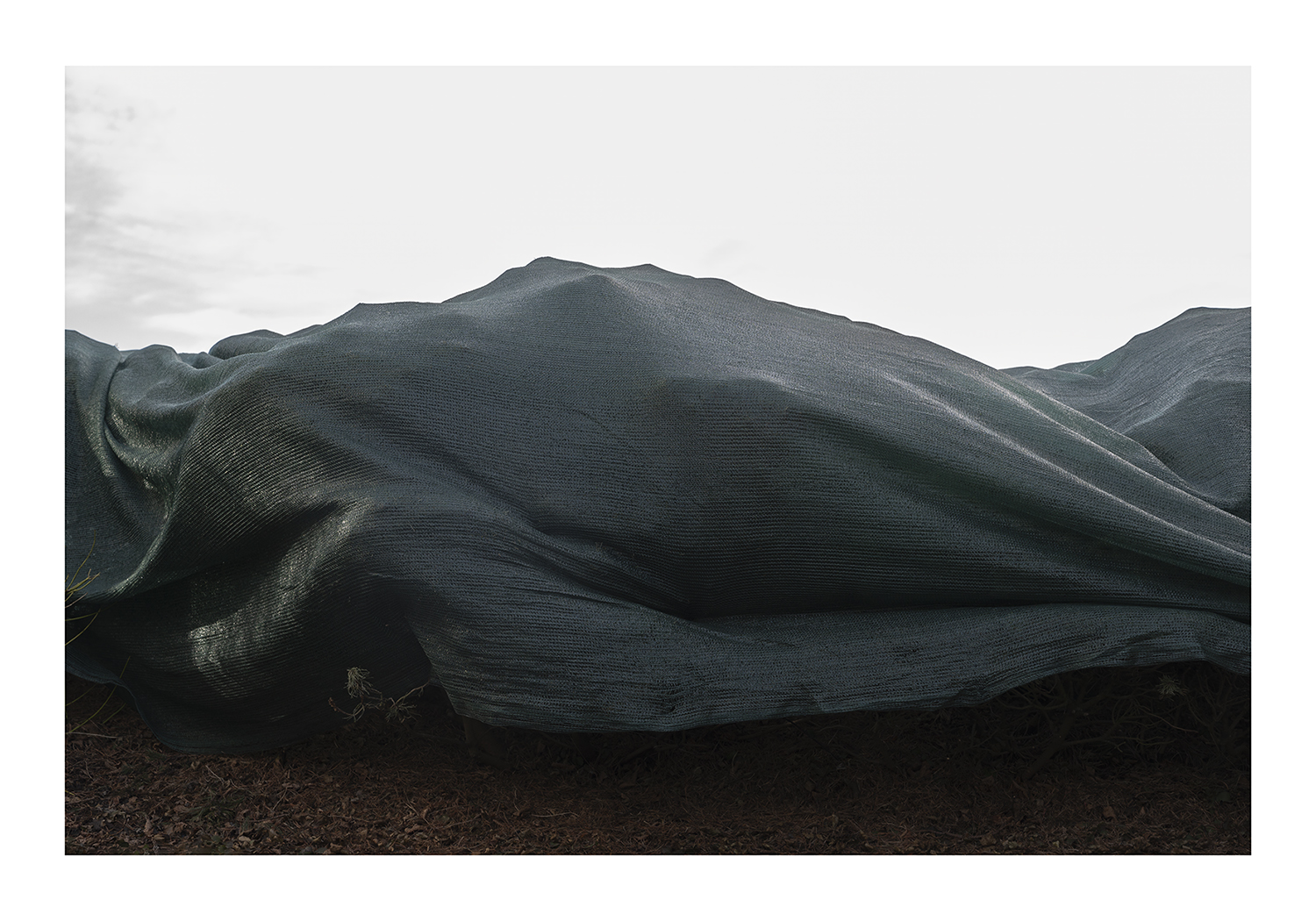
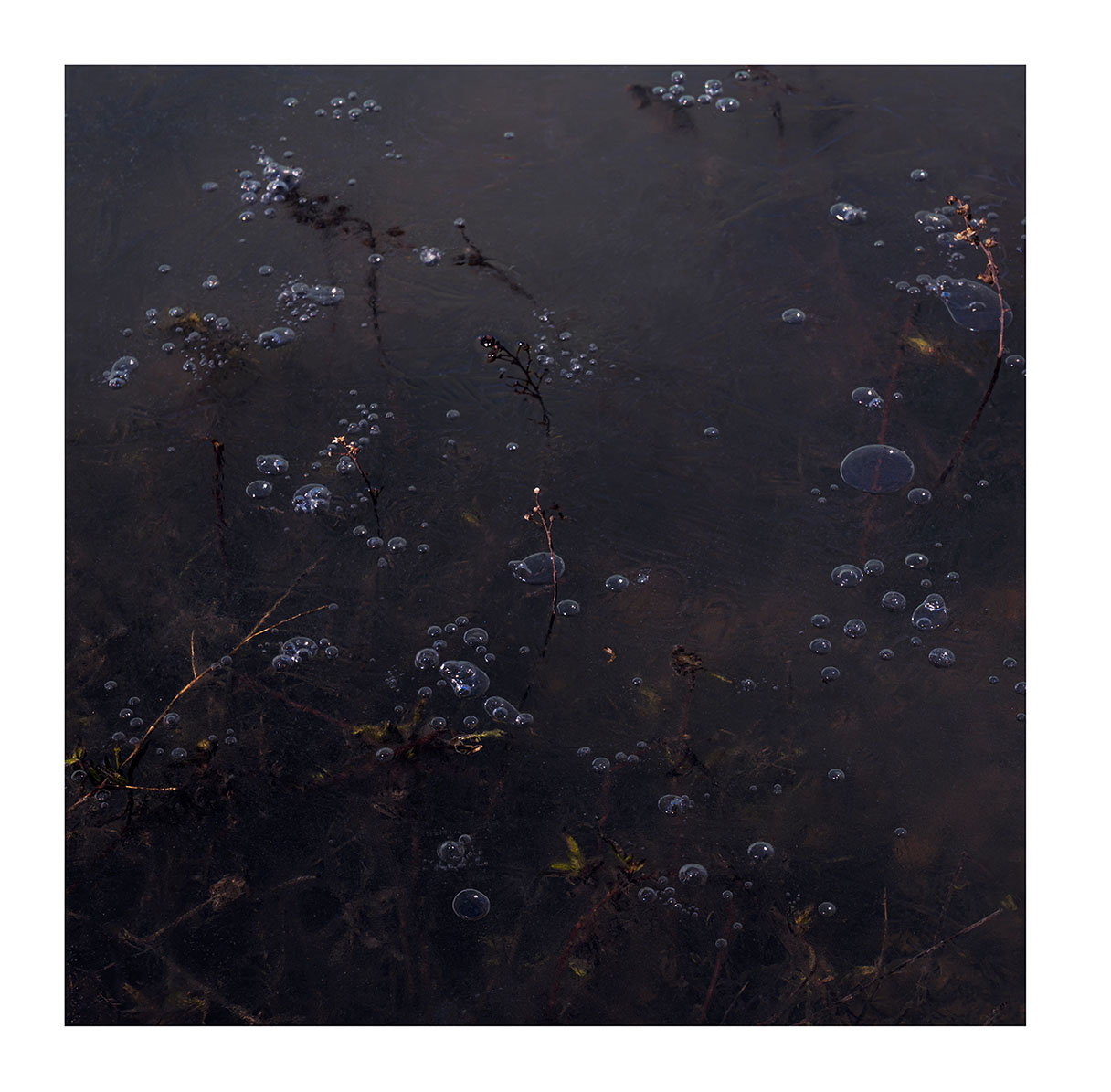
N.M: My relationship to Tarek’s work has started almost six years ago. One of the first series of his that I’ve seen was one about lost objects. From real lost objects looking for their owners, the viewer was progressively getting suspicious of the realness of the loss as the items were getting more and more absurd. What struck me was his way to doubt reality and a certain playfulness. Without expanding too much on the playfulness, we wanted here to expand on his relationship to doubt when oriented toward the different scapes: landscape, seascape, dreamscape. You look at a print and you cannot say with certainty whether you are seeing a sea, a mountain, or a pile of debris — and that hesitation is not a failure of the image, it is its subject.
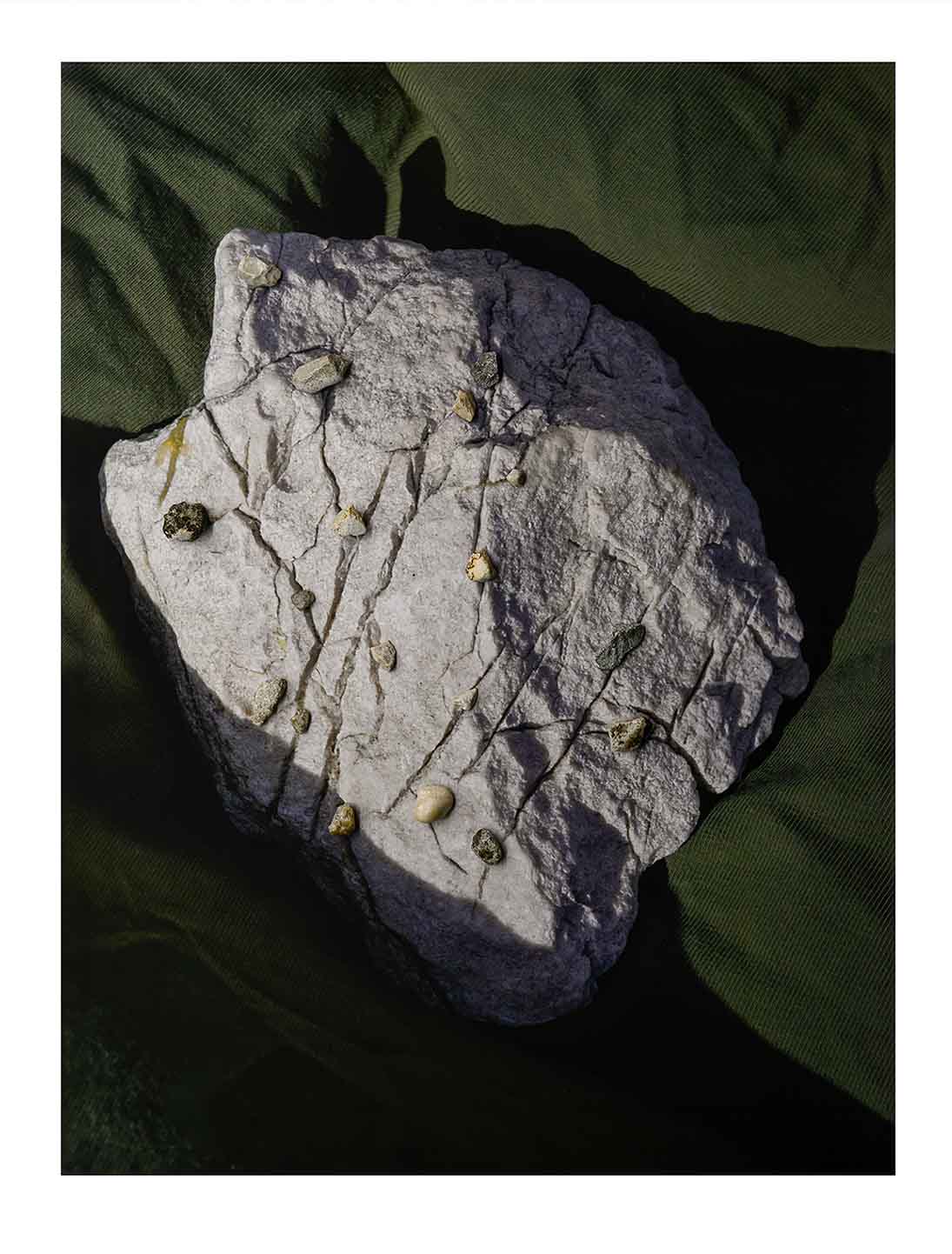
Photography has carried, since its invention, an implicit promise: that it records what is there. Tarek treats the print as a surface rather than a window. He places a stone on it, he introduces a ruler, he reorders the elements. The image becomes something one can hold and alter, not something one merely receives. The centre piece, the cubes, holds all of those feelings.
What drew me to this was the recognition that transformation, in his case, is not a formal exercise. It comes from a life divided between places: Lebanon, France, Finland, and the return. He is trying to reach something that may already have disappeared, and the manipulation of the image is the trace of that attempt. The method is bound to fail, and he knows it. That is precisely what makes it honest.
Your text draws compelling parallels between Tarek Haddad’s practice and the history of photography, from nineteenth-century scientific inquiry to the digital image. How do you see his work expanding the possibilities of the photographic medium today?
N.M: Tarek trained as a programmer before he did as a photographer. I always believed that an artist is first marked by biographical details, past or present, more than any artistic school he could make. In this case it places him in a lineage: to translate the world into art with preciseness.
We thought about the relationship to language in our recent talk at the gallery. Tarek’s speaks fluently Arabic, French, English and Spanish. He spends his life going from one way of expressing himself to another: this is translation.
Translation also has a mathematical meaning which applies here. It means moving every points of a figure, object, subject or force from one set of coordinates to another.
Therefore he is concerned with measurement, with protocol, with what light does to a surface, and maybe most important, how different artworks interacts with each other.
Of course, he isn’t using measurement to establish facts. Instead he uses it to demonstrate its failure. The ruler that appears in his images is not there to verify anything; it is there to show that the world resists being verified. This is where he differs from a conceptual tradition — Bernd and Hilla Becher, for instance — where the protocol produces objectivity. Here the protocol produces longing.
The other displacement concerns the material itself. He is not only interested in light as a source of images but in the way light imprints a surface — from silver paper to sensor. In a work like Approximate Exactitude, he tries to reproduce, using an enlarger and a blank negative, the exact cyan of undeveloped photographic paper. The print emerges visually identical to the paper, yet chemically transformed. And then the paper itself, once exposed, begins to drift away from its own colour, while the image stays fixed. The attempt to preserve is what creates the distance. If you come now to the gallery, it will already be very different to what it once was during the opening.
I think that is where he expands the medium: not by adding technology to it, but by treating photography’s claim to accuracy as a subject rather than a given. Is accuracy still relevant?
As Close As It Gets is deeply rooted in Tarek Haddad’s personal trajectory, an artist whose practice continually shifts between image and object, observation and intervention. How did your conversations together influence the final curatorial framework to find balance between his lived experience and the broader questions the exhibition raises about image-making, memory and place?
N.M: In the end I believe I really understood Tarek’s work upon my arrival here.
First, because I came to know a bit more the country, from the sea to the mountains, their realness and proximity are something that attracts one’s gaze, it is indeed very magnetic, and I’m not surprised it has drawn so many Lebanese artists, from Etel Adnan to Nadim Asfar or Gilbert Halaby’s exhibition we’ve just seen.
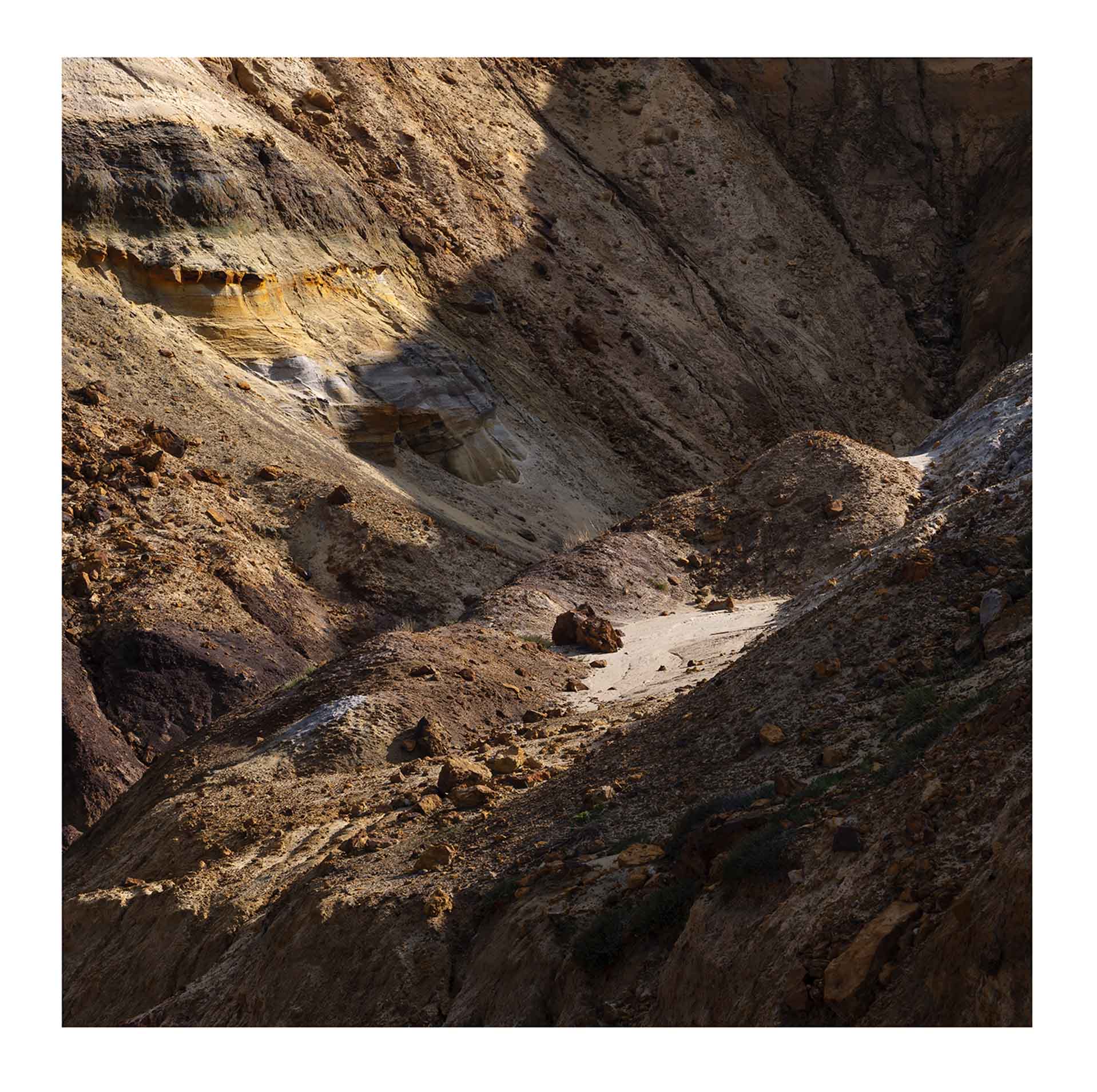
Second, because we’ve had very long talks about what could hold the last wall in front of Approximate Exactitude. I was aiming for a very classic and large landscape, one in which one’s eye could get lost, one in which any Lebanese would recognise the place. Tarek came to me with this Glitch, a photo he made very quickly, almost by accident, taking advantage of an error of his electronic shutter. He couldn’t (or did not want to) produce a classical landscape.
His topic at heart isn’t a specific territory, or a deadset of coordinates, but more to explore his dreamscape, one that would hold at the same time his childhood landscapes, but also all of the places he came across as well as all the people he met. His practice is not one of documentary, neither fully conceptual, but more one of poetry.
Scape comes from the same root than shape, to create, to give form. A landscape is not a given place; it is land that has been formed. Which is exactly what Tarek does: he does not repaint the mountain, he shapes it.
What I wanted was for the personal to be legible without being explanatory — so that a visitor who knows nothing about his life still encounters the same question: what do we do with a place we can no longer reach?
Your curatorial approach embraces ambiguity, allowing viewers to question what they are looking at. How important is it for you to preserve that openness when curating contemporary art?
N.M: I would distinguish ambiguity from vagueness. Vagueness is a failure of precision; ambiguity, when it is earned, is a form of precision about something that genuinely resists resolution.
In this case the doubt is not an effect added afterwards. It belongs to the work: Tarek’s landscapes have no coordinates, no names.
My role is to help the artist sticks to a vision and organise it. The curatorial text, the visible and readable part of my intervention is here to keep the possibilities open, not to close them.
That said, I do not think openness means withholding. The risk with ambiguity is that it becomes an alibi for saying nothing. The exhibition title, which Tarek found, As Close As It Gets, tries to hold both: the acknowledgement that we get near something, and the admission that near is where it stops.
Location: Galerie Tanit, Beirut
Duration: 16 July until 4 September 2026
About Nicolas Marbeau
Nicolas Marbeau is a French independent curator, and photographer, serving as the Special Project Manager for Contemporary Programmes at the Musée du Louvre. Formally trained at the École Nationale Supérieure de la Photographie in Arles, he expertly bridges the gap between historical heritage and modern artistic expression. Alongside curator Donatien Grau, Marbeau orchestrates innovative initiatives like Sous un toit, which connects global residency artists with the historic museum. In December, he will be moving as Head of exhibitions and curator at Fondation Van Gogh in Arles, France.